Rose
Franklin's Perennial & Butterfly Farm
Monarchs-And-Milkweed.com
Save
the Monarch
Monarch Education and Conservation
|
Rose
Franklin's Perennial & Butterfly Farm Save
the Monarch |
|
|
|
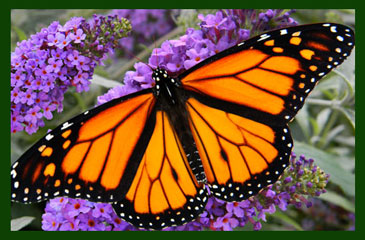
| This page is dedicated to the education
and conservation of Monarch butterflies. Here you will find information
on the present status of the Monarch population, learn the reasons for the
dwindling number of Monarchs, and find out what you can do to help
increase their numbers. You'll learn about the life cycle of a monarch and
come to understand why milkweed is so important in Monarch conservation. Gardening-oriented businesses and organizations can also, on this page, view our informative 'Save the Monarch' brochure which could be printed and used as a handout at special events your business or organization may be hosting or attending. The brochures too, are geared toward Monarch education and conservation. You'll find a sample brochure near the bottom of this page--and between here and there, a lot of informative paragraphs to read. With Monarch numbers plummeting in recent years, there is a chance this beautiful butterfly will be added to the Endangered Species List. Some people think this would be good. But I think there are reasons it shouldn't be added. You'll find my take on this controversial topic on this page. |

|
Plausible Negative
Consequences of Protecting the Monarch under the Endangered Species Act by Rose Franklin February 15, 2024 On
August 26, 2014, a petition was filed with the U.S. Secretary of the
Interior, through the United States Fish and Wildlife Service, to protect
the Monarch butterfly under the Endangered Species Act. The petitioners
(The Center for Biological Diversity, Center for Food Safety, The Xerces
Society, and Dr. Lincoln Brower) state that the North American Monarch
population has declined by more than 90% in the past two decades and may
be threatened with eventual extinction. I,
like most butterfly enthusiasts, am highly concerned by the drastically
reduced number of Monarchs. But I wonder if adding the monarch to the
Endangered Species List will help or hinder the Monarch population. I
wonder, too, if listing the monarch as an endangered species might, to an
even greater extent, deprive humans of its majestic beauty and further
increase the distance between mankind and nature. Once a species is listed
on the Endangered Species List, it is generally illegal to even touch this
species. Entomologists
agree that the most significant reason for the plummeting drop in the
Monarch population is that milkweed is being destroyed at an alarming rate
on agricultural grounds, where it once grew wild in abundance. Milkweed is
vital to the Monarch, for it is the host plant for Monarch larvae. Without
milkweed to feed the caterpillars, the butterfly cannot complete its
lifecycle and thus, the Monarch population cannot survive. Since
1996, when genetically-modified, Roundup-Ready crops were introduced,
milkweed has been rapidly disappearing from farmland. Farmers are now able
to plant seed without having to first till the soil, and then spray their
fields with Roundup to control the weeds. The herbicide kills the weeds
(including milkweed) but does not harm the crops. While only Roundup-Ready
soybeans were available in 1996, today the list of genetically-modified
crops includes soy, corn, canola, alfalfa, cotton, sorghum, wheat, and
sugarbeets. Well over 90% of the corn and soy being planted in the U.S.
today are Roundup-Ready varieties, and there certainly appears to be a
direct correlation between the use of Roundup-Ready crops and the
destruction of milkweed in rural North America. And most of the scientific
community seems to be in agreement that the loss of milkweed has likely
resulted in the alarmingly low number of Monarchs. Out
of concern that an iconic species might become extinct, the Endangered
Species Act was passed by Congress in 1973. The most serious threats to
endangered animal species have traditionally been shooting, poisoning, and
trapping. To address these concerns, Section 9 of the Endangered Species
Act states that it would be unlawful for any person “to harass, harm,
pursue, hunt, shoot, wound, kill, trap, capture, or collect” the species
in danger of extinction. Known as the “take clause,” Section 9 makes
it illegal for people to take the threatened species from the wild. The
government extended the “take clause” to sometimes include the
“taking of habitat which harbors, or could harbor, the endangered
species.” If
the monarch is added to the Endangered Species List, it will then be
illegal for anyone to take a Monarch from the wild, and if the Fish and
Wildlife Service determines at some point that milkweed is critical to the
Monarch’s survival, it may be illegal to harm, wound, or kill a milkweed
plant also. The
petitioners say they recognize the valuable roles that citizen scientist
monitoring and tagging, and classroom and in-home rearing of monarchs play
in monarch conservation and hence request that upon Endangered Species Act
listing, the Fish and Wildlife Service facilitate or waive permitting
requirements for teachers and citizen scientists, so long as their rearing
endeavors are
limited to raising 10 or less monarchs per year. How
likely is it that the Fish and Wildlife Service would allow teachers and
citizen scientists to rear Monarchs in the home or in the school if the
Monarch is added to the list? Not very likely at all! Rarely, very rarely,
has the Fish and Wildlife Service granted exceptions to the “take
clause” and permitted the general public to take the listed animal from
the wild and raise it in the home or in the school. If the Monarch is
indeed listed as a threatened species, it will likely be illegal for any
U.S. citizen (except for university professors who are studying the
insect) to harass, harm, pursue, wound, kill, trap, capture, or collect
Monarchs. It will almost certainly be illegal to collect any number of
Monarch eggs, caterpillars, pupae, or adults from the wild.
Some
teachers and citizen scientists, rather than collecting Monarch eggs
and/or caterpillars from the wild, purchase them from commercial butterfly
breeders, the industry that often provides adult Monarchs for release at
weddings, anniversaries, open houses, memorial services, and fund-raising
events. The petitioners, however, ask that all commercial breeding of
Monarchs be prohibited. Why? Because they somehow concluded that
commercial breeders were raising and releasing millions upon millions of
Monarchs per year, potentially interfering
with scientific studies on the distribution and movement of wild Monarchs
which, the petitioners claim, are increasingly important in light of
habitat loss and climate change. In reality, commercial butterfly breeders
produce significantly less than 10% of the number of Monarchs that the
petitioners suggested they do, even if the petitioners' "millions and
millions" meant only two million. Nonetheless, if the Monarch is
added to the Endangered Species List, and if the petitioners' request is
granted by the Fish and Wildlife Service, there will be no
commercial breeders for teachers and citizen scientists to obtain their
ten or less Monarch eggs and/or caterpillars from (should they be unable
to find them in the wild). And as I stated previously, is is highly
doubtful that the Fish and Wildlife Service would make an exception to the
"take clause" and allow Monarchs to be reared in the home or in
the school anyway. Personally,
I would be saddened to think that citizen scientists and school teachers
would be forbidden from raising Monarchs, thus denying children the
rewarding experience of observing the miraculous Monarch metamorphosis
first-hand. Watching a Monarch caterpillar chewing on milkweed is like
watching a child chew on an ear of buttered sweet corn. Seeing a
caterpillar pupate is nothing less than amazing, and witnessing the
emergence of a majestic Monarch butterfly from its chrysalis is simply
mystical. I would also be saddened to think that brides would be deprived of large, beautiful, brightly colored Monarchs on the most important day of their lives, and that those mourning the loss of a loved one might have to compromise for small, fast-flying, zig-zagging Painted Ladies instead of graceful, ballerina-like Monarchs. Everyone knows and loves the Monarch, and everyone wishes to have Monarchs released at their special event. And Monarch releases are an environmentally-friendly alternative to throwing rice and/or releasing balloons at weddings and other special events. For many people, a butterfly release is their first
close-up encounter with a live butterfly. In releasing Monarchs, people,
often for the first time, experience the amazing, relaxing, mesmerizing
feeling that butterflies bring to humans. Many people leave the butterfly
release with a goal of attracting Monarchs to their gardens. Some
newlyweds send a packet of milkweed seeds home with every guest. If
Monarch releases are banned by the Fish and Wildlife Service, all the
people who have experienced the joy of a Monarch butterfly release will
know that others are being deprived of something quite spectacular, an
experience that is beautiful and peaceful, and brings people a little
closer to nature. With so many U.S. citizens now aware of the fact
that Monarchs are dwindling in number because milkweed is rapidly
disappearing from the agricultural landscape, many are eager to aid the
Monarch in its quest to multiply. Americans have, in the last few years,
begun to plant milkweed seeds and plants by the tens of thousands. I know
this to be true because I operate a perennial nursery and have watched
milkweed sales skyrocket in recent years. And because the Monarch has an
enormous fan club, I have no doubt that milkweed sales will continue to
rise in coming years, in my nursery, and in hundreds more across the
nation.. Milkweed might be vanishing from rural farmland, but it is
popping up in home gardens, in city parks and state parks and national
parks, along nature trails, and in botanical gardens. Within a few years,
I suspect we will see that milkweed hasn't disappeared, but instead, was
simply redistributed. And with a dramatic increase in the number of
milkweed plants will come an increase in the number of Monarchs, this
assuming, of course, that droughts, floods, and violent storms don’t
take their toll on the population. The Monarch is no more at risk of extinction than
many other butterfly species. Those of us who garden for butterflies have
watched the population of most butterfly species dwindle over the past few
decades. Yes, the Monarch population has dwindled but so too have the
numbers of other butterfly species dropped dramatically. It is widely
accepted that (1) the loss of habitat, and (2) the
overuse of insecticides and herbicides are the two factors that have
contributed most to the diminishing butterfly population. Here in the
northeast, millions of woodland butterfly larvae have likely been killed
by aerial spraying that was intended to control the gypsy moth population.
Here and elsewhere, insecticides aimed at controlling mosquitoes and other
pestilent insects have probably wiped out thousands, and in all
likelihood, millions, more butterflies. Butterflies were not the intended
targets of the insecticide spraying, but they have certainly suffered the
consequences. I think the Monarch is fortunate in having an
audience that is alert to its needs and is willing to aid it in its time
of need. Other butterfly species are not so blessed. My opinion is that
the Monarch should not be listed as a Threatened Species. Listing it will
not likely increase its numbers and may actually decrease their numbers.
Planting more milkweed will most assuredly increase the population.
Listing the Monarch will likely make it illegal to raise Monarchs in the
home and in the classroom, illegal to release Monarchs at weddings and
other special events, and illegal to take Monarch eggs,
caterpillars, chrysalises, or adults from the wild for any purpose
(including education and display). Maybe Monarchs will even have to be
removed from butterfly houses and other such public displays too. Instead of supporting the petition to list the
Monarch as an Endangered Species, let’s all just plant more milkweed. I
feel assured that will more quickly increase the monarch numbers. Originally
it was thought that the U.S. Fish & Wildlife Service would rule on
whether the Monarch would be added to the Endangered Species List within a
few years of the petition being filled in 2014 but the U.S. Fish &
Wildlife put this decision on the back burner as there were too many other
rulings to be made about animal species that appeared to be more
threatened than the Monarch. It's now been over ten years since the
petition was filed and a decision has still not been made---but the
petition is still there and a ruling should one day be made. Added
March, 2026:
My husband and I are turning 75 and 80 years old this summer, both have
some health issues, and want to sell the business and retire. Until the
U.S. Fish & Wildlife Service makes it's decision on whether the
Monarch is going to be added to the Endangered Species List though, we
consider it is both unethical and unfair to sell the business. If the
Monarch is added to the Endangered Species List and Monarchs are no longer
permitted to be sold and reared, Monarchs-And-Milkweed.com won't be of
much value to whomever owns it at that point. So until that decision is
made, Andy (my husband) and I feel stuck right here, growing, selling, and
shipping Monarchs. |
|
Written by me (Rose Franklin) in May, 2025, and
added to the web site then: The U.S. Fish & Wildlife Service is proposing to add the
Monarch butterfly to the Endangered Species List as a threatened species
and if listed, intends to limit the number of monarchs that can be sold
per year by butterfly farmers like myself.
If the U.S.
Fish & Wildlife Service lists the Monarch as an endangered species it
is being proposed that these rules will apply: (1) no more than 250
monarchs could be reared per year by any individual or by any facility,
(2) that no more than 250 monarchs per year could be sold from any
facility (like a butterfly farm), and (3) monarchs would not be permitted
to be shipped across any state line. Since we often
ship more than 250 monarch larvae per week (and sometimes as many as 250
per day during our busy season), we'd be able to ship monarchs one or two
days per year. We’d only be able to fill 25 orders of 10 caterpillars,
and all of those orders would have to ship to Pennsylvania addresses
(since that’s the state we reside in and shipping to other states would
be illegal). Upon receipt of the first 25 Pennsylvania orders, our
shopping cart button would have to be removed from the web site and all
our other monarch customers turned away. If the U.S.
F&W Service prohibits butterfly farmers from shipping more than 250
monarchs per year and also deems it illegal to ship monarchs across the
state line, hundreds of teachers will likely be unable to obtain monarch
larvae for their classrooms. Many home hobbyists will also have no access
to monarch larvae. The reason the
U.S. F&W Service doesn't want the monarch to be reared in large
numbers is due to the fear of having diseased butterflies introduced into
the wild. I understand that concern but wonder if putting butterfly
farmers out of business wouldn’t have a negative impact on the monarch
population. There are only a few dozen
commercial butterfly farmers (also known as butterfly breeders) in the
entire United States. As is the case with any profession, there might
likely be a few, very few, butterfly farmers who lack the knowledge,
skill, integrity, and/or ethics to produce high quality butterflies. Most,
however, adhere to stringent standard operating procedures which
facilitate in producing a high-quality product. At a butterfly farm, adult
butterflies are protected from predators and monitored to assure their
environmental and nutritional needs are being met. Larvae are protected
from predators like ants, wasps, and Tachinid flies. The butterfly pupae
are protected from Chalcid wasps whose larvae will parasitize the
developing butterflies and kill them. Most commercial butterfly farmers
sanitize everything that comes into contact with the butterfly eggs,
larvae, and pupae. Even the milkweed being fed to the larvae is sanitized
prior to use. Professional butterfly
farmers are generally better butterfly caretakers than Mother Nature
herself. And all this extra care is highly appreciated by the retail
customers who purchase their eggs, larvae, pupae, and/or adults. Most school teachers know
that not only are monarch eggs and larvae difficult to find in the wild
but also often infected with disease. When attempting to teach the
miraculous life cycle of a monarch, it’s disheartening for both the
teacher and his or her students to see white fly maggots dropping from
their freshly-pupated monarch caterpillars, caterpillars which will now
die and decay inside the pupae and thus, produce no majestic monarch
adults. And from mid-August thru early September (when most teachers raise
monarchs in the classroom) a lot of the wild larvae are tainted with
Tachinid flies. If butterfly farmers are
only permitted to sell 250 monarchs per year, there will be hundreds of
teachers unable to obtain caterpillars for their classrooms. And from what
I’ve been told by the teachers who have been raising monarchs in the
classroom for a number of years, many of their students become adults who
protect and/or grow milkweed on their properties, this a direct result of
raising monarchs in the class room when they were young. Here's my issue
with adding the monarch to the Threatened List. The monarch is by far not
the only butterfly species that is losing ground in its struggle to
survive. Most butterfly species, in fact, have dramatically declined in
number over the past 40 years. From my observation the monarch is no worse
off than many other butterfly species. The monarch
though, is the butterfly used in classrooms for rearing projects and if
teachers won't be allowed to have monarchs, they will most likely have no
butterflies for their unit on butterfly life cycles (metamorphosis).
Swallowtails won't work for fall rearing projects because they overwinter
as pupae---and the pupae can't be overwintered in a classroom because
classrooms are much too warm. Many butterflies use trees as hosts and
trees can't easily be taken into classrooms either. I'm nearing retirement age (well actually, past it already) so it's not just that I am upset about losing the income from monarch sales. I am worried that if teachers can't have monarchs in the classroom, kids won't have that exposure to nature----and sadly, kids (except for Amish kids) are becoming less absorbed in nature with every decade that passes. One additional note: If the U.S. Fish & Wildlife Service adds the Monarch to the Endangered Species List, there is a very good chance that from that point on, no one will be permitted to take monarch caterpillars from the wild and raise them to adulthood. It will likely be illegal for butterfly farmers like myself to raise and ship Monarchs. It will probably be illegal for Monarchs to be released at weddings, memorial services, parties, and fundraisers. And it will likely be illegal for Monarchs to be displayed at state and county fairs and other community events. It might even be illegal to even touch a Monarch butterfly in any life stage. |
|
Comparing
the Monarch population to that of other butterfly species over the past 20
years
by Rose Franklin Recently the
results of the first national analysis of U.S. butterflies concluded that
these majestic creatures are disappearing from the national landscape at a
‘catastrophic’ rate. The lead study author was Collin Edwards, an
ecologist and data scientist at the Washington Department of Fish and
Wildlife. Nick Haddad, an entomologist at Michigan State University, was a
co-author. A compilation
of 76,957 surveys from 35 monitoring programs were blended together for
the analysis. The surveys were conducted by scores of volunteers who spent
hundreds of thousands of hours over the past several decades of summers
counting the various butterfly species in their local areas, this
according to Edwards. Then Edwards, Haddad, and a team of over 30
butterfly researchers combined and analyzed all the surveys. The study
included over 12.6 million recorded butterfly sightings over the past two
decades. The conclusion
of this countrywide systematic analysis was that the number of butterflies
in the contiguous U.S. has decreased by 22% between 2000 and 2020. Many of the species
included in the study declined by 40% or more. The Red Admiral is down by
44% and the American Lady butterfly decreased by 58%. Even the invasive
Cabbage White, a butterfly species whose larvae feed on cabbage, broccoli,
and cauliflower, fell by an astonishing 50%. According to
Edwards and Haddad, climate change, habitat loss, and insecticides have
likely worked together to weaken our butterfly populations. And based on
previous research from the Midwest, it appears that insecticides are the
biggest culprit. Now let’s
compare the population decreases from the national analysis of U.S.
butterflies to the population decrease of the Monarch butterfly to
determine if the Monarch warrants being added to the Endangered Species
List as a threatened species. The Monarch
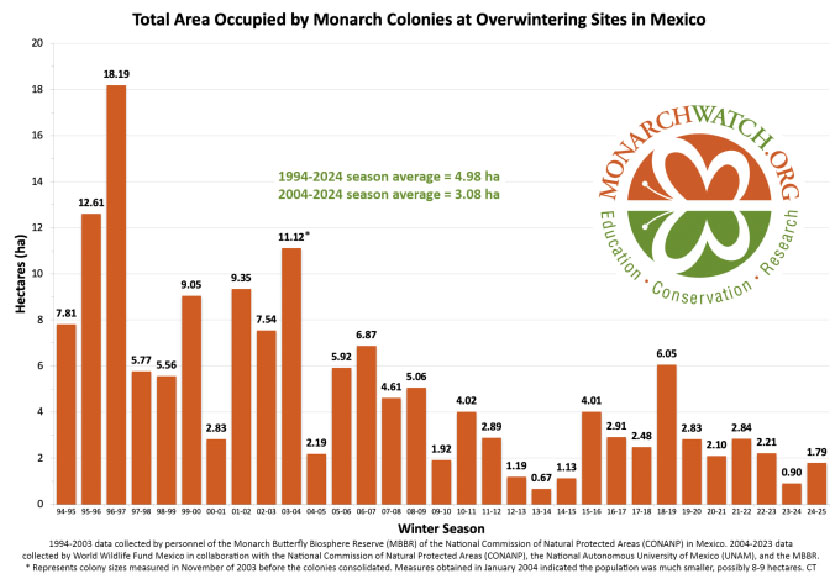
population has been monitored at the Mexican over-wintering grounds since
the winter of 1994-1995. To measure the population, scientists record the
total number of hectares that are occupied by Monarch colonies. For
reference, one hectare equals approximately 2.47 acres. During the
winter of 2000-2001 the total area occupied by Monarch colonies at the
over-wintering sites in Mexico was 2.83 hectares. During the winter of
2020-2021 the total area occupied was exactly the same, 2.83 hectares. But
those figures are not the numbers presented in the arguments for adding
the Monarch to the Endangered Species List. Instead the
proponents usually compare the winter of 1996-1997, the year the
population was at its highest in recorded history, to a more recent year.
During the 1996-97 winter, 28 years ago, Monarchs covered 18.19 hectares
of Mexican mountainside. Comparing that winter to the winter of 2020-2021
the proponents calculate that the Monarch population has decreased by 88%
since 1996-1997. What the proponents fail to publicly recognize is that
the population of 1996-1997 was extraordinarily large, far above the
average population size over the last 30 years of recorded history. Even if we
don’t compare the Monarch populations of 2000-2001 to 2020-2021 (which
were exactly the same at 2.83 hectares) and instead use the 20-year
average between 2000 and 2020, which was 4.40 hectares, the Monarch
population of 2020-2021 has decreased by 52%, which closely compares to
the 20-year decrease in the population size of the Red Admiral, American
Lady, and Cabbage White. I hope the U.S.
Fish & Wildlife Service decides against adding the Monarch to the
Endangered Species List and denying Monarchs to be used for school rearing
projects, summer nature programs, festival and fair exhibits, butterfly
releases, etc., the Monarch will be removed from the human-to-nature
connection and ultimately, people will no longer understand the
monarch-milkweed connection. Unless people associate the Monarch with
milkweed, few people will aspire to grow and/or protect existing patches
of milkweed. So long as there is a human-to Monarch connection, the
Monarch will be blessed with stewards who protect its needs. |
|
|
A note from me, Rose Franklin: For the many
reasons listed above, I hope the U.S.
Fish and Wildlife Service decides against adding the Monarch to the
Endangered Species List. If they do though I will forever have memories, fond memories
of when U.S. butterfly farmers were still allowed to raise monarchs and
share that majestic experience with others. I'll have memories of when my husband and I took monarch eggs, larvae, pupae, and adults into preschools and elementary schools and taught about the butterfly life cycle as hundreds of children listened attentively to our words. We even did this in a few Amish schools and always, in every school, did it free of charge. I'll have memories of when we voluntarily took adult monarchs to nursing facilities and allowed each resident to hold a monarch, look at it closely, and then release it. We've put butterflies into tiny, gentle hands and on wrinkled, age-spotted fingers. And whether the recipient was three or ninety-three years old, their eyes lit up and they smiled in awe of the majestic creature they were holding. Some of my most precious moments at nursing facilities were when we handed monarchs to ninety year old people in wheel chairs and saw tears streaming down their aged, cracked cheeks as they said something like "You know, I've done a lot of things in my life but this is the first time I've ever held a butterfly. Thank you for this amazing experience." Now that, my friends, is all the thanks I need for the long hours and hard work I have put into raising monarchs and milkweed for the past 30 years. |
 |
|
 |
| What we can do to help increase the Monarch
population:
Plant milkweed for them to lay eggs on. One of the milkweeds they highly favor for egg-laying
is Tropical Milkweed (Asclepias curassavica), a South American
native that must be treated as an annual in most of the U.S. In September
and October, Tropical Milkweed provides nectar for the Monarchs that are
migrating to Mexico. Plant nectar plants for the adult Monarchs to feed on.
Butterfly bushes (Buddleia
davidii), Purple Coneflower (Echinacea
purpurea), Meadow Blazing Star (Liatris
ligulistylis), Milkweed (Asclepias), and Zinnia are among their favorite nectar sources. Refrain from using insecticides and herbicides on your
property. Remember, butterflies are insects that might be harmed by
the insecticides you use, and herbicides might kill plants that are vital
to butterfly survival and
reproduction. Work to protect natural Monarch habitats (areas containing milkweed and wildflowers that can be
utilized for nectaring) from being disturbed or forever destroyed. Donate to Monarch Watch or
another organization dedicated to the conservation, education, and
research of Monarch butterflies. |
|
|
|
|
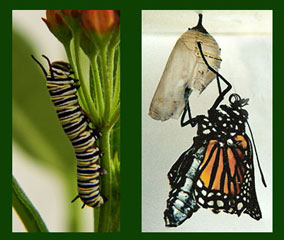
The Life Cycle of a Monarch Butterfly
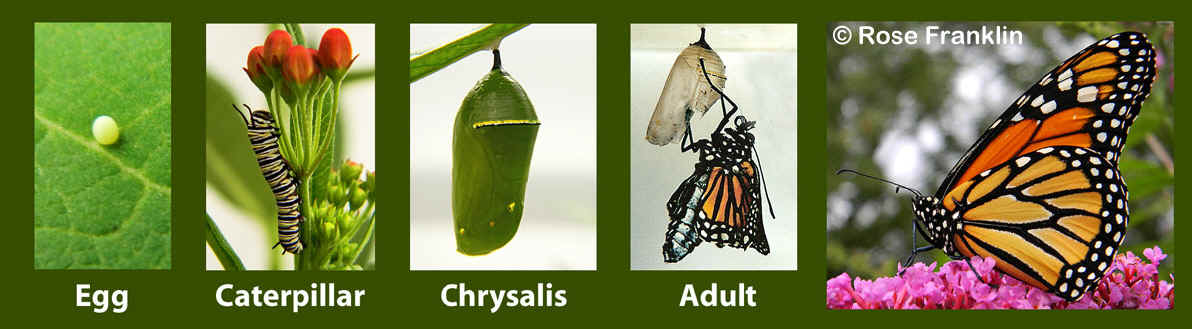
Eggs are laid on
milkweed plants by female Monarchs. They are generally deposited singly on
the undersides of leaves. A Monarch caterpillar hatches from the egg 5 to
7 days after it is laid. It is so tiny it can barely be seen, but just 10
to 14 days after hatching, it is fully grown, about 2
3/8” long. It
has grown (and become distasteful to birds) by feeding on a strict diet of
milkweed. |
|
The Monarch Migration
Some Monarchs are permanent residents to Florida and California. Most,
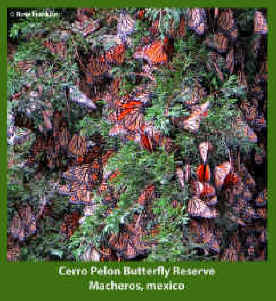
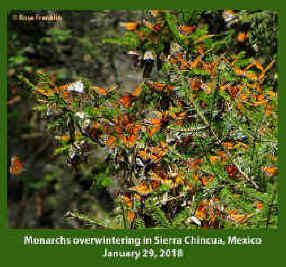
those that are summer residents east of the Rocky Mountains, migrate to central Mexico for the winter. There, high in the
oyamel fir forests west of Mexico City, Monarchs are protected from
freezing temperatures from November through late February. Late February
through mid March, the butterflies mate and then begin the journey north. Milkweed
plants are now in growth mode in Texas and this is where they will enter
the U.S. to begin the northward pilgrimage. |
 |
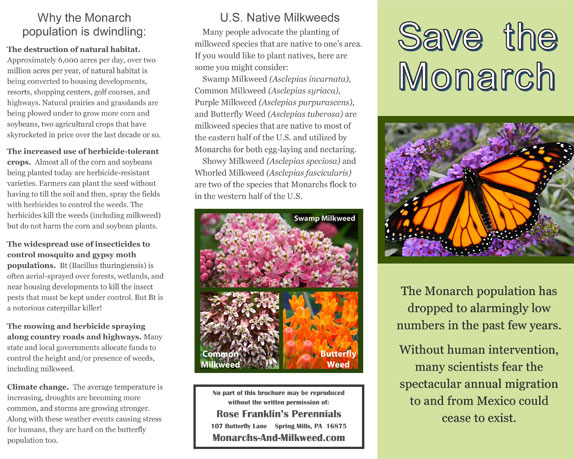
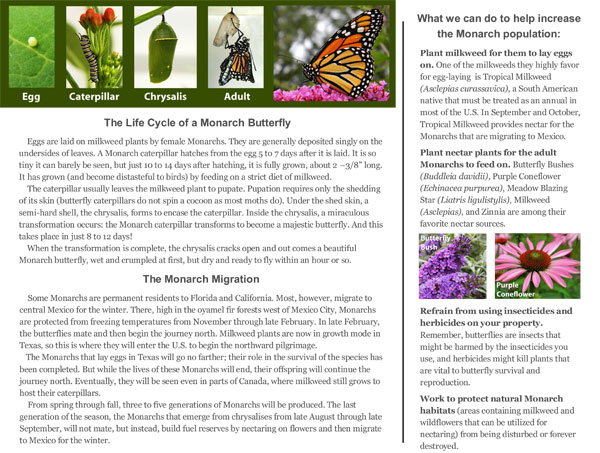
'Save the Monarch'
brochures
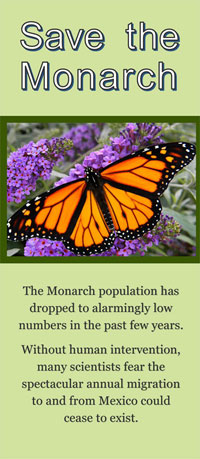
I, Rose Franklin, created the 'Save the Monarch' brochure to educate
the public on the obstacles facing the Monarch and urge readers to assist
the Monarch in its struggle to multiply. We are now sold out of the brochures and have no intention of getting more printed. I will send the PDF to any organization that would like to print the brochure for distribution. I highly suggest you print the brochures on 24#, simi-gloss paper. Just send me an email and MilkweedLady@aol.com and ask for PDF. My company name, address and web site address will be on the back of
the brochure (Rose Franklin's Perennials, my address, and
www.Monarchs-And-Milkweed.com). |
|
Brochure Outside: |
Brochure Inside: |
|
|
|
|
|

|
Rose Franklin's
Perennials (814)
422-8968
Email: MilkweedLady@aol.com |
Copyright © 2002-2026. [Rose Franklin's Perennials]. All rights reserved.
Revised: February 26, 2026